-According to a 2000 study by the Pan American Health Organization, young women in Juárez between the age of 15 and 24 have a homicide mortality rate 12 timeshigher than El Paso and 3 times higher than Tijuana.
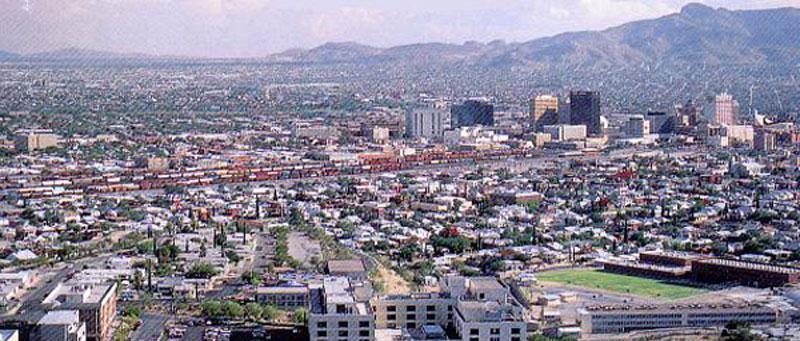 | 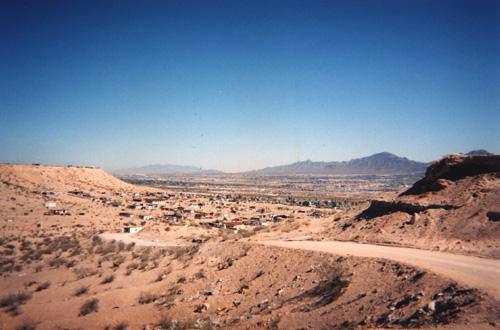 |
As one of the largest bi-national metropolitan areas in the world, Ciudad Juárez is steeped in a transitory and constantly shifting history. The uneven development growth rate exacerbates the disparities prevalent in the city. As a victim of globalization, drug cartels, and widespread violence, the residents of Juárez are subject to a battery of assaults living in this border city.
*Export-processing zones: In Ciudad Juárez, globalization has been exemplified in its liberal economic agenda. Since 1965, when the Border Industrialization Program (BIP) was initiated, free trade zones became an integrated part not only of the border’s economy, but of all aspects of life in border cities. The BIP opened up Mexico’s border cities to foreign economic interest, primarily in the form of U.S. owned factories, or maquiladoras.[1] Built to manufacture a plethora of goods at low cost by utilizing extremely cheap labor, Mexican maquiladoras often have an overwhelmingly female workforce because of the widely-held belief that they will accept lower wages and tolerate higher levels of harassment.
*Drug cartels: In the 1970s and 1980s, border states in Mexico, especially Tijuana and Ciudad Juárez, became important points of entry for the booming drug industry after a tightening of drug enforcement along the coasts of Florida. Best explained as a combination of the new importance of the border for drug trafficking and increasingly organized and well-financed Mexican drug cartels, “it was a combustible and deadly formula guaranteed to profoundly disrupt the normal way of life in many Mexican border communities.”[2] Criminals and other advantageous people looking for ways to make quick cash were drawn to the border cities and the local environment grew more dangerous every day. It did not take long for the growing drug cartels to permeate the local police force, government offices and other law enforcement agencies. Important to emphasize is that the advent of strong drug cartels in Ciudad Juárez forced its citizens “to alter their lifestyles as they have sought to stray away from potentially dangerous places, including theaters, restaurants, bars, and nightclubs patronized by traffickers.”[3] Border cities like Juárez are now battlegrounds for drug cartels to exert power, influence, and profit financially.
*Violence: Ciudad Juárez is the most dangerous city in Mexico, according to the Secretaría de Desarrollo Social. The death rate has risen exponentially since the narcotraffickers presence in Juárez increased. Between 1993 and 2002, the conservative homicide estimate was nearly two thousand people. As author Oscar Martínez reports in his book Troublesome Border, the “violence has continued unabated in Ciudad Juárez up to the present, with constant reports of shootouts, disappeared persons, and discoveries of mass graves.”[4]
*Population Growth and Migration: With
the shift toward a globally oriented economy, Ciudad Juárez experienced a sharp
increase in its population and began to attract immigrants by the
thousands. Data from the Instituto
Nacional de Estadística y Geografía (INEGI) places the population of Juárez at
over 1.3 million (as of 2005 when the last census was conducted). Only 15 years earlier, in 1990, the
population was just under 800,000.[5] Also important to take into account is
the growing migrant population, drawn to Juárez by the promise of jobs in the maquiladoras. In 2000, the INEGI counted
approximately 525,000 immigrants living in Juárez, although these numbers are
hard to verify due to the complications of counting migrants. Alma Guillermoprieto best captured the
effect of migration on Juárez by stating that “the rootless nature of Juárez is
like a mold in the atmosphere.”[6]
[1] 2004 – Femicides in Ciudad Juárez.” Mexico Solidarity Network, http://www.mexicosolidarity.org/specialreports/2004femicides, 19-20.
[2] Oscar J. Martínez, Troublesome Border, (Tucson: The University of Arizon Press, 2006), 141.
[3] Ibid., 142.
[4] Ibid., 144.
[5] 2004 – Femicides in Ciudad Juárez.” Mexico Solidarity Network, http://www.mexicosolidarity.org/specialreports/2004femicides, 30.
[6] Alma Guillermoprieto, “One Hundred Women,” The New York Times, September 29, 2003.
