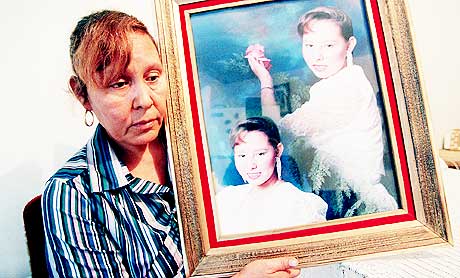
 Olga Alicia Carrillo Perez's mother, Irma with a photo of her deceased daughter.  Picture of Paloma Escobar Ledezma. 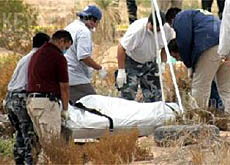 Body found in desert. |
Sagrario Gonzalez Flores, a 17 year old girl who worked in the General Electric maquiladora,
disappeared on her way home at the end of a shift on April 16, 1998. It was still light out when Sagrario
was abducted and most likely occurred in Juárez’s downtown. Her body was found 12 days later in the
outskirts of Juárez. Seven
years later, in 2005, police finally detained suspects in Sagrario’s
case.[1] Olga Alicia Carrillo Perez, at age 20, disappeared on August 10, 1995 in downtown Juárez. An active member of the Partido Acción
Nacional’s (PAN) youth group and an employee at a local shoe store, Olga was
last seen going to a PAN youth meeting.
Her body was found a month later in an empty parcel of land, raped and
mutilated. When interviewed,
Olga’s mother Irma spoke of how the authorities changed their story more than
once. First, they claimed the body
was found in Lote Bravo, but later it changed to Lomas de Poleo. Irma was given a bag of bones by the
police and told nothing else remained even though Olga had only been dead
around a month.[2] Paloma Escobar Ledezma
disappeared on March 2, 2002 and her body was found March 29 in a dry riverbed
on the outskirts of Juárez. She
worked at a maquiladora and took classes at a computer school in downtown
Juárez on weekends. In 2005,
Paloma’s family filed a complaint with the Inter-American Commission on Human
Rights, claiming that after two and a half years, the Mexican authorities had
yet to make any progress on Paloma’s case. Also in the petition was a complaint that the Mexican
Attorney General’s Office had planted incriminating evidence in order to find
Paloma’s boyfriend guilty of the murder.
Still, no progress has been made on Paloma’s investigation within
Mexico.[3] While each woman’s story is different, some commonalities
can be drawn among the killed women of Juárez. Most women killed were young, dark-haired, dark-skinned, and
skinny. Alma Guillermoprieto, in her article “One
Hundred Women” expands on this by explaining, “their most important
characteristic, however, had to do with race and class: dark-skinned,
long-haired young girls waiting at a bus stop or emerging from a factory are
likely to come from families that are poor and nearly defenseless in a
bureaucratic, overloaded, and user-hostile legal system.”[4] The other similarity is the lack of
support, cooperation, and respect for those killed from the authorities. Families of femicide victims can often
be found protesting throughout Juárez, “denouncing the offensive treatment they
had themselves received at the hands of the police – the jokes, the laughter,
the obscene insinuations about the victims’ secret lives.”[5] [1]
Diana Washington Valdez, The Killing Fields,
(Burbank, California: Peace at the
Border, 6), 35-39. [2] Ibid., 7-9. [3]
Inter-American Commission on Human Rights, Petition 1175-03, Paloma Angélica
Escobar Ledezma Et. Al. Mexico, March 14,
2006, http://iachr.org/annualrep/2006eng/ Mexico.1175.03eng.htm. [4] Alma
Guillermoprieto, “One Hundred Women,” The New York Times, September 29, 2003. [5] Ibid. |
