*Nuestras Hijas de Regreso a Casa A.C. is an organization in Ciudad Juárez composed of families and friends of victims. Their website is accessible in eight languages and includes many different articles, artistic expressions, and links to other sources about the femicides. http://www.mujeresdejuarez.org/
*“A Hundred Women,” by Alma Guillermoprieto
is an article published in The New Yorker that explains the femicides of Juárez and Chihuahua City as
a spreading epidemic exacerbated by a failure of the Mexican justice
system. It also explores the
gendered and class-based roots of the femicides. http://www.newyorker.com/archive/2003/09/29/030929fa_fact_guillermoprieto?currentPage=all *The Killing Fields by Diana Washington Valdez is one of the few books written about the femicides. Valdez, as an investigative reporter who spent many years in Juárez trying to de-mystify these murders, includes an extensive account of who has been killed and takes the time to include analyses of all the theories surrounding the femicides. She also has a blog that is updated regularly. http://www.dianawashingtonvaldez.blogspot.com/ *Mexico Solidarity Network is an organization based in Chicago that supports community-based, grassroots mobilization. Most important to know about this organization is that they offer study abroad programs, one of which addresses border dynamics and gender issues, especially violence against women. http://www.mexicosolidarity.org
*"Mexico: Intolerable Killings: 10 Years of Abductions and Murder of Women in Ciudad Juárez and Chihuahua" is an important report published by Amnesty International in 2003 that shed light on the Mexican government’s failure to investigate, punish, and prevent femicides. It also lays out recommendations for Mexico to adopt that would lead to a more hospitable and safe environment for women. http://www.amnesty.org/en/library/info/AMR41/026/2003/en *The Argentine Forensic Anthropology Team (EAAF) has worked in the state of Chihuahua since 2001, producing reports every year that update their forensic work on the remains of women from Juárez and Chihuahua City. The EAAF team in Mexico exhumes, analyzes, and attempted to identify the remains of femicide victims. http://eaaf.typepad.com/cr_mexico/ *“The Juárez Murders,” by Debbie Nathan was published in the Amnesty International magazine and emphasizes the maquiladora industry and its relationship to femicides. http://www.amnestyusa.org/amnestynow/juarez.html *2666 is the last book written by the acclaimed author Roberto Bolaño. A story that uses the premise of the femicides of Juárez and takes place in the fictitious border town of Santa Teresa, Bolaño writes about a transitory city and the people drawn to it. *Troublesome Border by Oscar J. Martínez provides an overview of the U.S-Mexico border. As an important part of understanding femicides is having a sense of the atmosphere, history, and social issues along the border. Especially important to be aware of are the border issues of migration, drugs and violence.
Women and Migration in the U.S.-Mexico Borderlands, edited by Denise A. Segura and
Patricia Zavella is a compilation of scholarly works regarding gender and
migration issues for Mexican women.
“Toward a Planetary Civil Society,” by Rosa Linda Fregoso, “The
Dialectics of Still Life: Murder,
Women, and Maquiladoras,” by Melissa W. Wright, and “Manufacturing Sexual
Subjects: ‘Harrassment,’ Desire,
and Discipline on a Maquiladora Shopfloor,” by Leslie Salzinger are just three
of the pertinent articles in this reader for understanding femicides. El Paso Times and El Diario are important resources in keeping up-to-date with recent developments and current events in the border communities. With the growing crime and violence in Juárez, articles regarding these topics are added almost daily. | 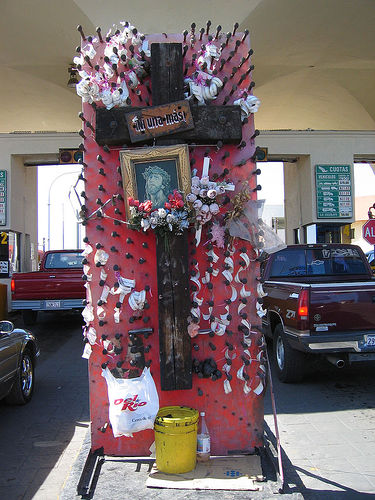 Monument on the U.S.-Mexico border dedicated to the murdered women in Juárez. 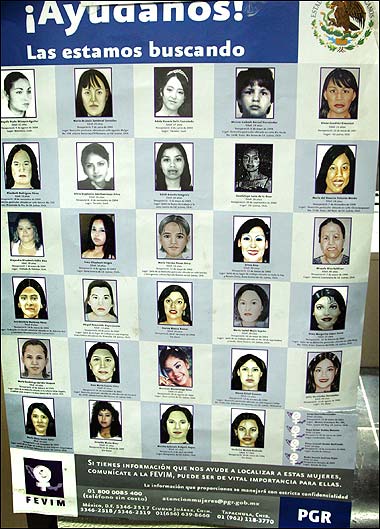 Poster of missing women in Juárez. |
