"Or gynophobia, which is fear of women, and naturally afflicts only men. Very widespread in Mexico, although it manifests itself in different ways. Isn't that a slight exaggeration? Not a bit: almost all Mexican men are afraid of women...What do you think optophobia is? asked the director. Opto, opto, something to do with the eyes. In a figurative sense, that's an answer to what you just said about gynophobia. In a literal sense, it leads to violent attacks, loss of consciousness, visual and auditory hallucinations, and generally aggressive behavior."
-excerpt from Roberto Bolaño's, 2666
**********************
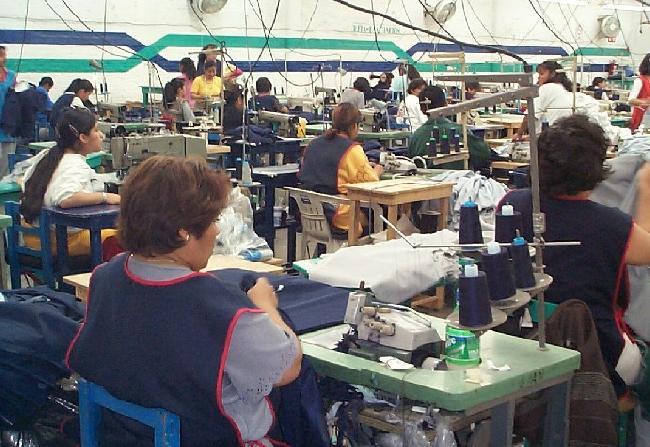 | 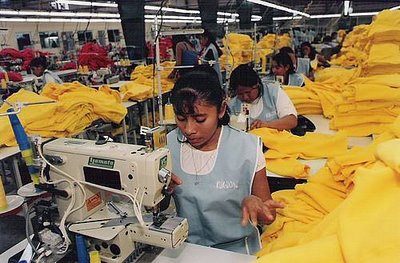 |
To tackle the huge issue of sexism and machismo relevant to understanding femicides, an analysis of the inner-workings of a maquiladora can begin to shed light on the problem. Because it focuses on the way in which sexism and the economy are often intertwined, it directly addresses the relationship between femicides and maquiladoras. Early in an article by Leslie Salzinger about the sexualization of female maquiladora workers, she makes the claim that young women are “embodiments of availability – cheap labor, willing flirtation…the paradigmatic workers for a transnational political economy in which a highly sexualized form of femininity has become a standard ‘factor of production.’”[1]
Panoptimex,
a television manufacturer in Juárez, provides an example of how a company has
turned its workforce into sexual objects.
Housed in a panopticon-shaped building, Panoptimex filters all aspects
of the employment hierarchy through a structure in which the powerful can see
everything the employees do while working. As a result of this mentality, young women are hired
according to physical features at Panoptimex.[2] Coupled with the view of women as
“workers of declining value since their intrinsic value never appreciates into
skill but instead dissipates over time,”[3]
sexual objectification becomes even more dangerous for women in Juárez. The woman’s disposability in the maquiladoras translates into disposability in all other areas of
her life.
A
general and broad depiction of machismo
illuminates the power this concept can play on a Mexican’s life. Stereotypical characteristics of the macho male figure in Mexico include strength, virility,
stubbornness, defender, protector and importantly, the provider.[4] All of these features that distinguish
and define Mexican men are threatened by the increasing number of women
entering the workforce, assuming the bread-winning duties in households, and
asserting non-traditional roles within the social realms of their lives. Because of this perceived threat, men
respond with aggressiveness, and overcompensation for their lack of control
over the changing social landscape.
In essence, Mexican women, as a result of the changing circumstances of
their lives, have disrupted the traditional power structure in Mexico.
[1] Leslie
Salzinger, “Manufacturing Sexual Subjects: “Harassment,” Desire, and Disciple on a Maquiladora
Shopfloor,” in Women and Migration in the U.S.-Mexico Borderlands, ed. Denise A. Segura and Patricia Zavella, (Durham
and London: Duke University Press,
2007), 161.
[2] Ibid., 163.
[3] Melissa W. Wright, “The Dialectics of Still Life: Murder, Women, and Maquiladoras,” in Women and Migration in the U.S.-Mexico Borderlands, ed. Denise A. Segura and Patricia Zavella, (Durham and London: Duke University Press, 2007), 186.
[4] Evelyn P. Stevens, “Mexican Machismo: Politics and Value Orientations,” The Western Political Quarterly, Vol. 18, No. 4 (Dec., 1965), 848-849.
*************************
"One word sums up the aggressiveness, insensitivity, invulnerability and other attributes of the macho: power. It is force without discipline or any notion of order; arbitrary power, the will without reins and without a set course."
-Octavio Paz
