As a result of the continuing femicides, many of the victims’ mothers decided to organize and form grassroots movements dedicated to stopping violence against women in Ciudad Juárez. After attempting the traditional route of looking to the authorities for help, most mothers realized that they would have to find an alternative solution if they wanted to find their daughters and work toward ending the endemic violence. Because the local police do not investigate cases of missing people until at least 72 hours after a disappearance is reported, family members of many missing women conduct their own rastreos, or searches. Mothers put up flyers throughout downtown Juárez, try and find witnesses, and follow any leads they stumble across. Many mothers started sharing information among themselves once they realized how futile the authorities were; Esther Chavez, founder of a human-rights lobbying group in Mexico, has been a vital part of making sure the femicides are well-documented, an important part of working towards transparency. Building relationships with non-governmental organizations such as the Coordinator and the 8th of March feminist group, the mothers learned how to organize effectively.[1] In 1998, Voces Sin Eco formed, the first organization to accommodate families of victims. This group quickly collapsed due to its inability to agree on a course of action and also because authorities worked to undermine the group’s effectiveness. Nuestras Hijas de Regreso a Casa formed in 2002 and has become the most prominent and vocal group of mothers organized in Juárez. Once the local authorities in the city realized the determination and capacity to draw attention to the femicides, there was an official attempt to incorporate “the mothers into government social programs, a blatant effort to buy their silence in exchange for monthly stipends.”[2] Refusing to partake in any kind of government-sponsored reconciliation programs, the mothers continue to struggle and fight for bringing justice and safety to the women of Juárez. How the mothers of Juárez fight back Marches: Numerous marches have been organized
throughout Juárez, to the State Capitol building in Chihuahua City, and in
Washington D.C. to the Organization of American States headquarters. The largest march occurred in February
2004 (a Valentine’s Day march) that included many mothers, NGOs, and U.S. human
rights organizations; Jane Fonda, Sally Field, and U.S. state representatives
also marched. Letter-writing campaigns: These are organized at the state,
national, and international levels and are often supplemented by NGOs like Amnesty
International. Traveling tours/testimonies: A few of the more vocal mothers have spoken at university campuses in the United States and have been invited by NGOs to speak at events throughout the States as well. Norma Andrade, mother of femicide victim Lilia Alejandro Garcia Andrade, told her story in December 2003 at a Congressional hearing in the United States. This opportunity gave her a platform in which to draw public attention to the negligence committed by the Mexican government. | 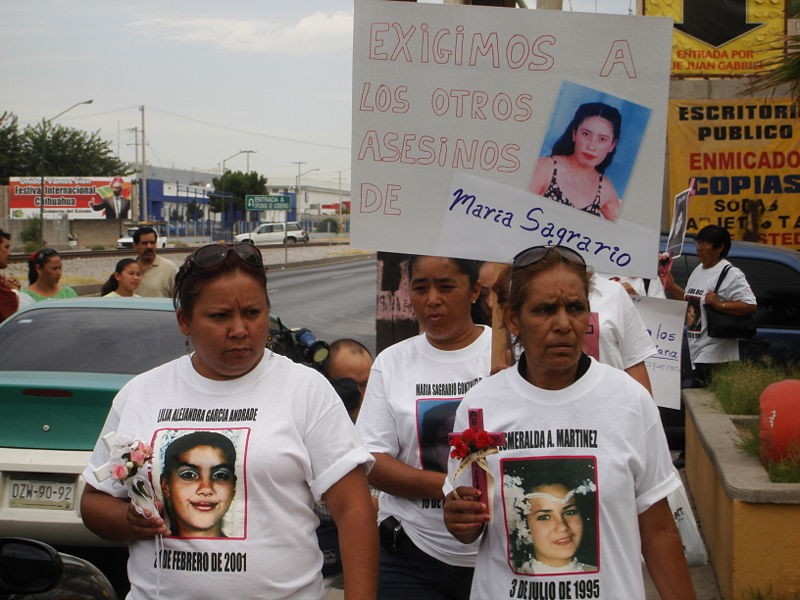 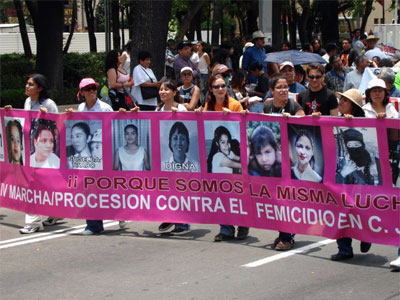 Mothers and family members of femicide victims during their marches. |
